How to downsize your home to 200 to 400 square feet
Room-by-room keep lists, a selling and donating plan, and the storage-unit math that changes most people's minds.
Going from a typical house to 200 to 400 square feet means keeping roughly a tenth of the floor space, so downsize by measured space, not by feel. Decide what the new home holds first, then fill it from your best things and let the rest go. Skip the storage unit: at January 2026 national averages, a 10 by 10 costs $1,428 to $1,608 a year, which is more than most of what goes into one is worth.
The short answer
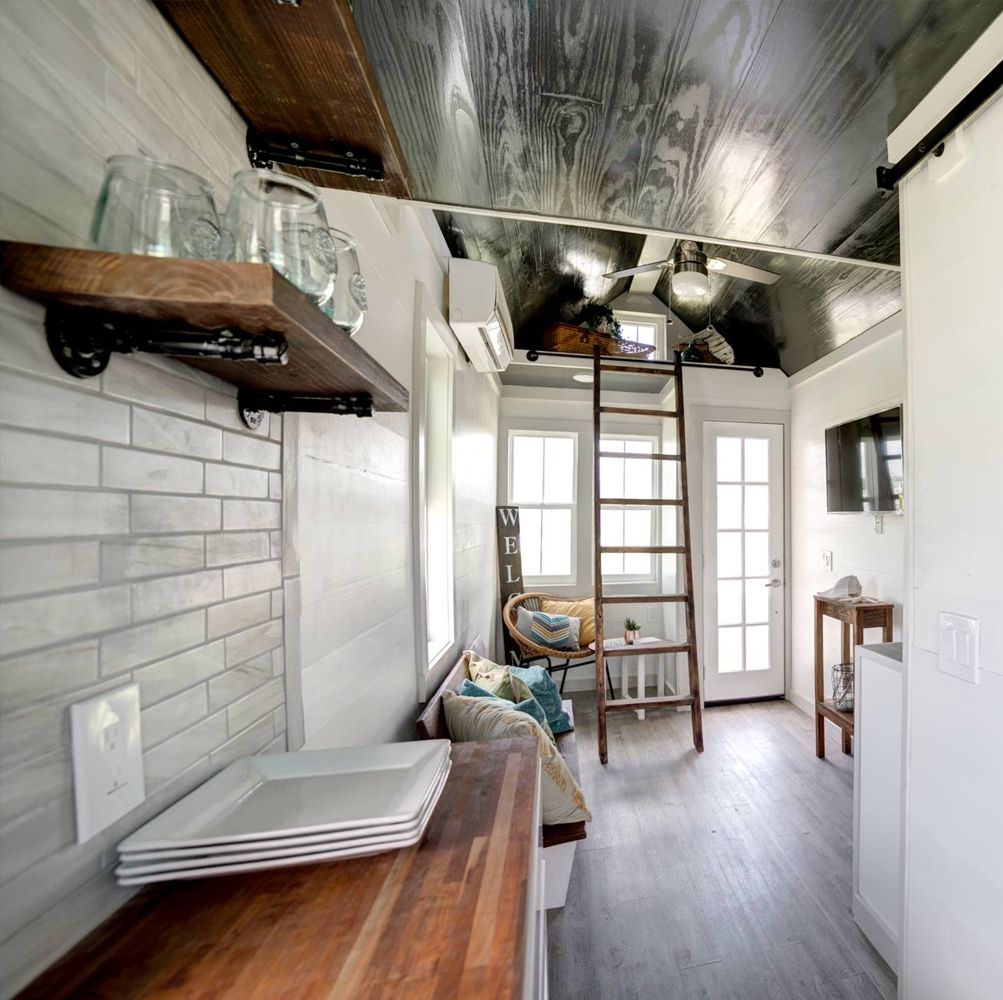
The median new single-family house completed in 2025 was 2,142 square feet (Census Bureau). Tumbleweed's "Tiny" size is 249 square feet plus a loft; Escape's Traveler XL is 344. Moving from one to the other means fitting your life into roughly a tenth to a sixth of the floor area.
You can't get there by trimming. You get there by deciding what the new space holds, then choosing the best of what you own to fill it. Everything else goes.
Step 1: Measure the new space before you touch the old one
Downsizing by feel fails because "this doesn't take up much room" is true of every individual item. Measure instead:
Our square footage planner helps you map this out. Ideas for squeezing more out of the space are in tiny house storage ideas.
Downsizing planner
Go room by room: keep, sell, donate or toss. Get a dated 30-day plan you can print.
Try itStep 2: The fill order
Fill the measured space in this order, and stop when it's full:
- Daily: what you use every day (toothbrush, coffee setup, work gear, current-season clothes)
- Weekly: cleaning supplies, laundry, the pots you actually cook with
- Seasonal: one set of cold-weather gear, one set of rain gear
- Emergency: first aid, hurricane kit, documents
- Meaningful: a defined amount of sentimental items
Anything still on the floor after step 5 has to replace something already in, or go.
Step 3: Room by room
Kitchen
A tiny kitchen typically means a 24-inch range or a two-burner cooktop, a 24-inch fridge and a single sink.
Keep: one good chef's knife and a paring knife, one large and one small pan, one pot, a sheet pan, a cutting board, place settings for the number of people who live there plus two, a few mixing bowls that nest.
Let go: single-use gadgets, duplicate utensils, the bread maker you used twice, a 12-piece cookware set, specialty bakeware, most of the mugs.
Watch for: small appliances. Pick the one or two you use most; counter space is the scarcest thing in a tiny kitchen. Compact options are compared in small kitchen appliances.
Bedroom and closet
Keep: current-season clothes that fit and get worn, one set of nice clothes, two sets of sheets per bed.
Let go: "someday" sizes, duplicates of basics beyond what fits in your drawers, shoes you don't wear, extra bedding.
Watch for: the bed itself. A queen Murphy bed like the Bestar Pur needs 92 inches of clear floor from the wall when open. A loft bed needs code-compliant access (see tiny house furniture).
Living room
Keep: seating for the household plus one or two guests, one table that works for meals and work.
Let go: coffee tables, side tables, entertainment centers, most decor.
Watch for: big upholstered pieces. IKEA's FRIHETEN sleeper sectional is 90.5 inches wide by 59.5 inches deep; in an 8.5-foot-wide house, that's most of the room. A gateleg table like IKEA's NORDEN folds to 10.25 inches deep and opens to about 60 inches, seating 2 to 4.
Bathroom
Keep: what you use daily, one backup of each consumable.
Let go: half-used bottles, duplicate tools, hotel toiletries, extra towels.
Watch for: the toilet you'll be living with. A composting toilet like the Nature's Head Standard holds solids for 60 to 80 uses, about a month for two people. More in tiny house bathroom.
Garage, shed and attic
This is where houses hide the most stuff. Sort into: tools you'll need at the new place, tools you can borrow or rent when needed, and everything else. Sell power tools and yard equipment you won't use; they hold value better than furniture.
Paper and photos
Scan, shred, keep originals only for documents that require them (titles, birth certificates, passports, wills). Photos: scan the best, offer originals to family.
Step 4: Sell, donate, trash, fast
| Route | Best for | Time | Money |
|---|---|---|---|
| Sell online | Furniture in good shape, tools, electronics, bikes | Weeks | Some |
| Estate or garage sale | Large volumes of mid-value items | One or two days plus prep | Some |
| Give to family | Heirlooms, things with stories | Days | None |
| Donate | Clothes, housewares, books | Hours | Possible tax deduction if you itemize |
| Trash or recycle | Broken, stained, expired | Hours | None |
Rules that keep it moving:
- Price to sell. Your old couch is worth what someone will pay this week.
- 48-hour rule: anything in the donate pile leaves the house within two days.
- Two-week rule: anything listed for sale that hasn't sold in two weeks gets donated.
On tax deductions, the IRS has long required donated clothing and household items to be in good used condition or better, and charitable deductions only help if you itemize. Check current IRS rules before counting on a deduction.
The storage unit trap
The most common downsizing mistake is renting a unit "just for now."
National average monthly rent, January 2026 (Yardi Matrix data via SpareFoot):
| Unit | Non-climate-controlled | Climate-controlled |
|---|---|---|
| 5 x 5 | $52 | $53 |
| 5 x 10 | $74 | $82 |
| 10 x 10 | $119 | $134 |
| 10 x 15 | $156 | $179 |
| 10 x 20 | $193 | $232 |
What that adds up to (our math):
| Unit | 1 year | 3 years | 5 years |
|---|---|---|---|
| 10 x 10, non-climate | $1,428 | $4,284 | $7,140 |
| 10 x 10, climate | $1,608 | $4,824 | $8,040 |
In Florida's heat and humidity, anything sensitive to moisture (wood furniture, paper, electronics) belongs in the more expensive climate-controlled column.
Ask before renting: would I buy these things again today for what the unit will cost me? For most used furniture, the answer is no. If you do need a unit, set a hard end date and put it on your calendar.
A countdown that works
Work backward from your move date, and give the hardest categories the most time:
| When | What |
|---|---|
| As early as possible | Measure the new space; list what it holds |
| Early | Garage, attic, basement and any storage unit (the biggest volume) |
| Middle | Furniture: decide, list for sale, arrange pickups |
| Middle | Kitchen, closets, books and media |
| Late | Paper and photos (scan, shred, distribute) |
| Last weeks | Daily-use items, packed only into the measured space |
| Moving day | Anything left that doesn't fit goes to donation, not storage |
If the new home is a tiny house on wheels, add one step: weigh what you're bringing. Clothes, books and kitchen gear add up on a trailer with a fixed weight rating. See the tiny house trailer guide.
Downsizing in Tampa Bay
Three local things are worth planning around if you're downsizing in Tampa, St. Petersburg or anywhere in Hillsborough and Pinellas:
- Time it around hurricane season. The Atlantic season runs June 1 to November 30, with most activity between mid-August and mid-October (National Hurricane Center, checked October 2026). A garage sale, an estate sale or a moving truck is much easier to schedule in spring than in September.
- Use the city's bulky-item pickup for what won't sell. Tampa's SWEEP program gives eligible residential customers one free scheduled bulky pickup a year, in a pile up to 10 cubic yards; off-schedule pickups cost $18.12 per cubic yard, and building materials, electronics and yard waste aren't accepted (City of Tampa, checked October 2026). St. Petersburg picks up furniture, carpet and appliances free up to 3 cubic yards when you request it, and charges $25.65 per cubic yard for other bulk (City of St. Petersburg, checked October 2026). Other cities and unincorporated areas run their own programs.
- Check the mover. Florida requires every mover and moving broker to register with the Florida Department of Agriculture and Consumer Services (Fla. Stat. 507.03, checked October 2026). Ask for the registration before you sign anything.
If you rent storage for the gap between homes, climate control matters here more than most places (see above). Run your own numbers in the storage unit calculator. Moving into a tiny house or backyard cottage locally? Check Tampa Bay ADU rules and are tiny homes legal in Florida first.
Step 5: Move in, then wait
Once you're in the new place, give it a month before buying anything to "fix" storage. You'll learn what you actually use. Most first-month purchases solve problems that disappear once you settle in.
Related reading
- Just starting? How to start minimalism
- What smaller living really saves: minimalist living cost savings
- Picking the house: how much a tiny house costs and where to park a tiny house
Questions people ask
How do I decide what to keep when downsizing to a tiny house?
Measure the storage in the new space first, then fill it in order of use: daily items, then weekly, then seasonal. Anything that doesn't fit after that has to justify replacing something already in. Floor plans with real cabinet and closet dimensions make this concrete; our square footage planner helps you lay it out before you move.
Should I rent a storage unit when I downsize?
Usually not. A 10 by 10 unit averaged $119 a month non-climate-controlled and $134 climate-controlled in January 2026 (Yardi Matrix data via SpareFoot). Over three years that's $4,284 to $4,824. If the contents aren't worth more than that, or you won't use them within a set time, sell or donate them instead.
What furniture fits in a tiny house?
Furniture that folds or does two jobs. A gateleg table like IKEA's NORDEN is 10.25 inches deep folded and about 60 inches long open. A queen Murphy bed such as the Bestar Pur needs 92 inches of clear floor from the wall when open. Measure doors and stairs too; big pieces often can't get in.
How long does it take to downsize a house?
It depends on how much you own and how much help you have, so start earlier than feels necessary. Working one room at a time with a firm rule that donations leave within 48 hours keeps it moving. Leave sentimental items and paperwork for last; those take the most time per item.
What should I do with sentimental items when downsizing?
Keep a small, defined amount: one box or one shelf, not a room. Photograph the rest, offer family heirlooms to relatives before you donate, and scan photos and letters. The goal is to keep the memory, not every object attached to it.
Where can I get rid of furniture when downsizing in Tampa or St. Pete?
Sell or donate anything with value first. For the rest, Tampa's SWEEP program gives eligible residential customers one free scheduled bulky-item pickup a year, up to 10 cubic yards, and St. Petersburg picks up furniture, carpet and appliances free up to 3 cubic yards when you request it. Check your own city's rules before you put anything at the curb.
Sources
- U.S. Census Bureau — Characteristics of New Housing highlights (2025)
- SpareFoot — Self-storage industry statistics (Yardi Matrix, January 2026 prices)
- Tumbleweed Tiny House Company — Home page (model sizes)
- TinyHouse.com — Escape Traveler XL listing
- IKEA — NORDEN gateleg table
- IKEA — FRIHETEN sleeper sectional
- Staples — Bestar Pur 65W queen Murphy bed
- AJ Madison — Summit RE2411W 24 in electric range
- AJ Madison — Summit FFBF121WIM 24 in refrigerator
- Nature's Head — Composting toilet models
- IRS — Year-end giving tips, IR-2012-102 (historical)
- National Hurricane Center — Tropical cyclone climatology (season dates) (checked October 2026)
- City of Tampa — SWEEP bulky item collection (checked October 2026)
- City of St. Petersburg — Special pickup (checked October 2026)
- Florida Statutes 507.03 (2025) — Registration of movers and moving brokers (checked October 2026)
Prices and rules change. We list the date we checked; confirm anything you're about to spend money on with the seller or your local permitting office.