Tiny house bathrooms: toilets, showers and ventilation
Toilet options with real specs and prices, the code clearances a tiny bathroom has to hit, and how much exhaust fan you need.
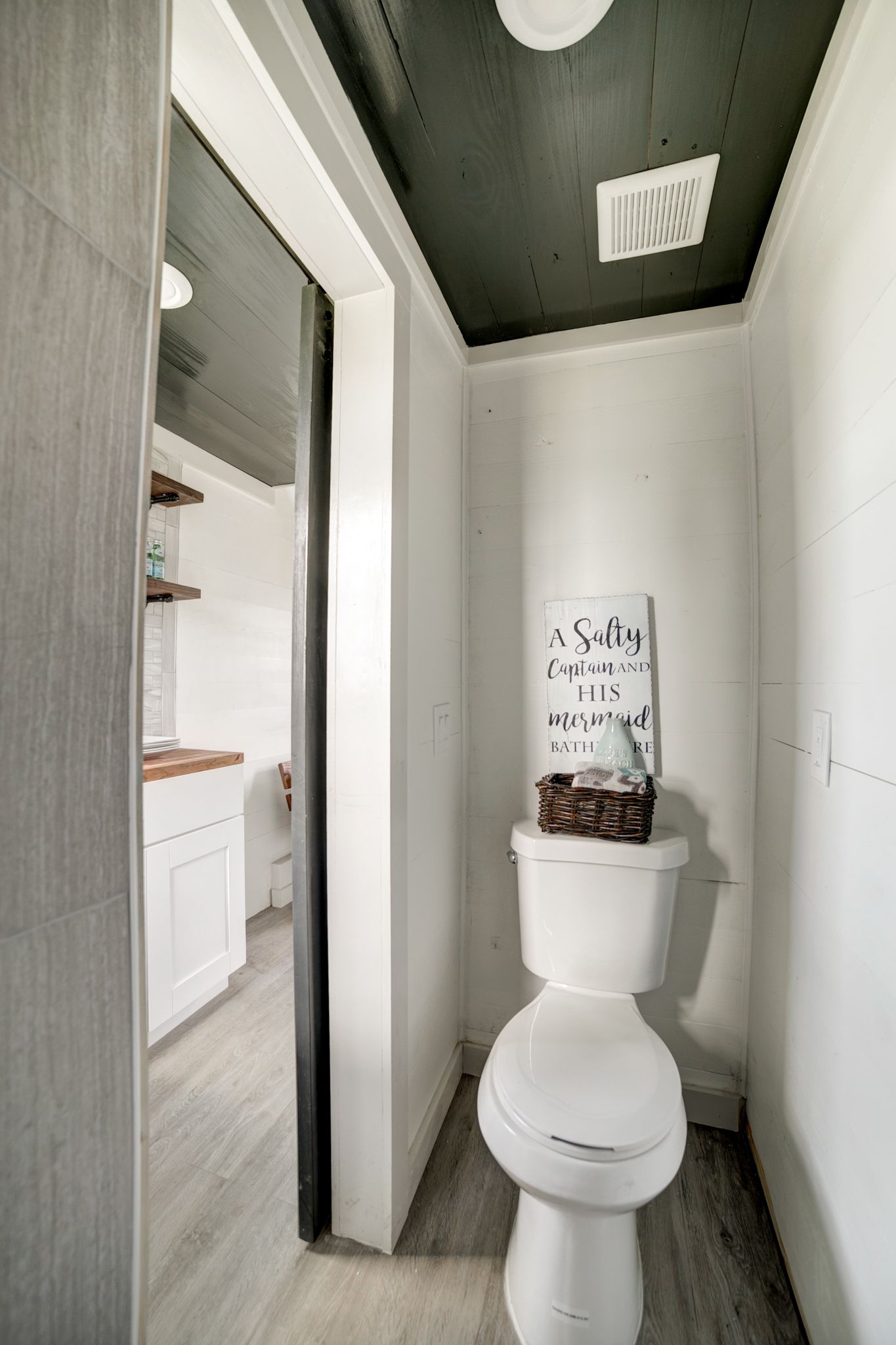
A tiny house bathroom has to fit three code numbers: a toilet centered at least 15 inches from side walls with 21 inches clear in front, a shower of at least 900 square inches and 30 inches across, and a ceiling of at least 6 feet 4 inches. Composting toilets like the Nature's Head ($965) cut water use, and Florida allows them if they meet NSF/ANSI 41, but you still need a legal path for shower and sink water.
The short answer
A tiny house bathroom is three decisions:
- The toilet: flush (needs sewer or septic), composting (needs a graywater plan and emptying) or incinerating (needs serious power).
- The layout: separate shower or wet bath, sized to code clearances.
- The air: an exhaust fan vented outside, sized to code.
Product picks below are based on published specs and prices, not on our own testing.
The code numbers you have to fit
| Element | Minimum | Source |
|---|---|---|
| Toilet centerline to side wall, vanity or partition | 15 in | IRC R307 (via Learn Architecture) |
| Clear space in front of toilet | 21 in | IRC R307 |
| Sink centerline to side wall | 15 in | IRC R307 |
| Clear space in front of sink | 21 in | IRC R307 |
| Shower interior area | 900 sq in | IRC P2708.1 |
| Shower smallest dimension | 30 in (or 25 in if the shower is at least 1,300 sq in) | IRC P2708.1 |
| Bathroom ceiling | 6 ft 4 in | Tiny house appendix (Appendix Q) |
| Exhaust fan | 50 cfm intermittent or 20 cfm continuous | IRC M1505 (via Larimer County) |
Clearances are measured to finished surfaces, not framing. Florida's Building Code includes the tiny house appendix; check the rest with your building department.
What that adds up to
Our math from the minimums above, for a toilet and shower side by side:
- Toilet zone: 30 in wide (15 in each side of center). A Nature's Head toilet is 19 in deep, plus 21 in clear in front, so about 40 in deep.
- Shower: 30 by 30 in at minimum.
- Together: about 60 in wide by 40 in deep before walls, door and sink.
That's the core of the smallest practical bathroom. Add a sink and you need another 30 in of width (15 in each side of its center) or a corner sink.
Square footage planner
Pick your bed, kitchen and bath. Watch the floor plan draw itself and see what trailer length you need.
Try itToilets compared
| Nature's Head Standard | Separett Villa 9215 | Incinolet TR | Standard flush toilet | |
|---|---|---|---|---|
| Type | Composting, urine-diverting | Urine-diverting, dry | Electric incinerating | Water flush |
| Price | $965 (Nature's Head) | $989 (Nomadic Supply) | $3,299 to $3,549 plus $100 delivery | Varies |
| Size | 21 x 19 x 19 in, 23 lb | Listed as 26.5 x 18 x 21.3 in (spec table differs) | 17 x 21 x 24 in, 85 lb | Varies |
| Power | 12 V fan, 0.07 A | 0.06 kWh per 24 h | 2,000 W at 120 V or 3,500 W at 240 V; 20 A dedicated circuit | None |
| Liquids | 2.2 gal internal bottle | Diverted to graywater, soak-away or tank via sloped hose | Burned | To sewer or septic |
| Solids capacity | 60 to 80 uses (about a month for 2 people) | About 3 weeks for 4 daily users | Burned to ash | To sewer or septic |
| Needs | Vent, place to empty | Vent (runs up to 20 ft), downhill drain for urine | Vent, big electrical circuit | Sewer or septic, water supply |
Nature's Head
Nature's Head lists four models at $965 each: Standard, two urine-diverter versions (multi-directional and through-the-floor, which route liquids to an external tank or plumbing) and a smaller Weekender (16.75 in tall, 1.7 gal bottle, 30 to 40 uses). All need 2 inches of rear clearance to remove the bowl and carry a 5-year warranty. The fan runs on 12-volt DC; a 110-volt adapter is sold separately.
Separett Villa 9215
The Villa diverts urine out of the toilet through a hose that must slope downward its whole length, to a graywater system, a soak-away or a holding tank. Solids go into a lidded container you empty. Energy use is listed at 0.06 kWh a day, and noise under 30 dB(A). The retailer's page lists two different sets of dimensions, so confirm with the seller before framing.
Incinolet TR
Burns waste to ash. No water, no compost, but the power draw (2,000 to 3,500 watts on a 20-amp dedicated circuit) makes it a poor match for solar-only houses or 30-amp RV hookups. See off-grid tiny house for the power math.
Florida's rules on waterless toilets
Florida's onsite sewage rule, 62-6.009, allows waterless, incinerating and composting toilets that meet NSF/ANSI 41 or NSF Protocol P157 (for incinerating toilets). Key conditions:
- Graywater and other wastewater must still be collected and disposed of under the rule
- Toilet liquids must be plumbed into the onsite system
- Solids get mixed with lime, containerized and disposed of with solid waste
- For residences using these toilets for all toilet waste, the required drainfield area is reduced by 25%
Bottom line: a composting toilet makes your septic system smaller; it doesn't eliminate it. Confirm what your county health or environmental office will permit before you build. More Florida rules in are tiny homes legal in Florida.
Showers
Size
At least 900 square inches with no side under 30 inches, so 30 by 30 in is the minimum square. If you go narrower, the code allows a 25-inch dimension only if the shower is at least 1,300 square inches (for example, 25 by 52 in).
Water
Standard showerheads use 2.5 gallons per minute; WaterSense-labeled heads use no more than 2.0. EPA says replacing showerheads with WaterSense models can save the average family more than 2,700 gallons a year. On a holding tank or rainwater, that's the difference between refilling weekly and refilling twice a week.
Wet bath vs separate shower
| Wet bath | Separate shower | |
|---|---|---|
| Space | Smallest; shower shares floor with toilet | Needs a shower footprint plus toilet clearances |
| Waterproofing | Entire room, one floor drain | Shower pan or base only |
| Daily life | Toilet and sink get wet when you shower | Dry toilet area |
| Composting toilet fit | Keep the toilet's vent and fan protected from spray | Easier |
| Cost | More waterproofing, fewer fixtures | Shower base and door or curtain |
Ventilation
A tiny bathroom fills with steam fast, and in a tiny house that moisture goes straight into the living space and loft. IRC-based mechanical codes require a bathroom exhaust of at least 50 cfm intermittent or 20 cfm continuous, vented outdoors.
Composting toilets add their own vent: Nature's Head and Separett both run small fans and need a vent to the outside. Plan both vent routes before framing the roof.
Humidity and mold in Florida
Florida makes this harder. Tampa's average relative humidity is about 86% in the morning and 58% in the afternoon over the year, and morning averages reach 88% to 89% in August and September (Florida Climate Center, NCEI data, checked October 2026). EPA's mold guidance is to keep indoor relative humidity below 60%, ideally 30% to 50%, and to dry anything wet within 24 to 48 hours (EPA, checked October 2026).
- Run the exhaust fan during every shower and after it, or install a fan rated for continuous use
- Keep the air conditioning on in humid months instead of opening windows, and put a cheap hygrometer in the bathroom to check you're under 60%
- In a wet bath, squeegee the walls and floor after showering
- Use tile or waterproof panels in the spray zone, and closed storage that tolerates moisture
- Hang towels where air moves, not in a closed cabinet
Bathroom planning checklist
Fitting the bathroom into the whole plan? Lay it out first, and budget it in tiny house cost.
Questions people ask
What is the minimum size for a tiny house bathroom?
Work from the fixtures. IRC-based clearances put a toilet's centerline at least 15 inches from any side wall with 21 inches clear in front, and require a shower of at least 900 square inches with no side under 30 inches. Side by side, that's roughly 60 inches of width. The tiny house appendix allows a 6 foot 4 inch bathroom ceiling.
Are composting toilets legal in Florida?
Yes, under Florida's onsite sewage rule 62-6.009, if they comply with NSF/ANSI 41 (or NSF Protocol P157 for incinerating toilets). Graywater from the shower and sink still has to go to an approved system, and toilet liquids are plumbed into the onsite system. Homes using them for all toilet waste can have a 25% smaller drainfield.
How often do you empty a composting toilet?
It depends on the model and how many people use it. Nature's Head says its standard model's solids tank holds 60 to 80 uses, about a month for two people, and its 2.2-gallon urine bottle needs emptying more often. Separett says four daily users fill the Villa's container in about three weeks.
What size exhaust fan does a tiny bathroom need?
IRC-based mechanical codes require bathroom exhaust of at least 50 cfm if it runs intermittently or 20 cfm if it runs continuously, vented outdoors. In a tiny house, where the bathroom shares air with the whole home, a quiet fan rated to run continuously is one code-compliant option. Vent it outside, never into the loft or roof cavity.
What is a wet bath?
A bathroom where the whole room is waterproofed and the shower sprays over the same floor as the toilet and sink, with one floor drain. It saves the space a separate shower stall and curb take up. The trade-off is that everything gets wet when you shower, so pick fixtures and storage that tolerate it.
Is an incinerating toilet a good idea for a tiny house?
Only with strong electrical service. The Incinolet TR needs a 20-amp dedicated circuit and draws 2,000 watts at 120 volts or 3,500 watts at 240, which rules it out for small solar systems and makes it hard on a 30-amp RV hookup. It also costs $3,299 to $3,549, more than three times a composting toilet.
How do I keep a tiny house bathroom from getting moldy in Florida?
Control humidity. EPA recommends keeping indoor relative humidity below 60 percent, ideally 30 to 50 percent, and drying wet areas within 24 to 48 hours. In Tampa, where morning humidity averages about 86 percent, that means an exhaust fan vented outdoors, air conditioning running in humid months and a hygrometer to check the level.
Sources
- Nature's Head — Composting toilet models
- Nature's Head store — Composting toilet product page
- Nomadic Supply — Separett Villa 9215
- Incinolet — Model TR electric incinerating toilet
- Fla. Admin. Code R. 62-6.009 — Alternative systems (Cornell LII)
- Learn Architecture — Minimum bathroom size (IRC R307 clearances)
- Building Code Trainer — Minimum shower size (IRC P2708.1)
- Georgia DCA — Tiny houses appendix (IRC Appendix Q text)
- Larimer County — Whole-house mechanical ventilation (IRC M1505 summary)
- EPA WaterSense — Showerheads
- EPA WaterSense — Statistics and facts (Jan 2025 snapshot)
- Florida House — CS/HB 557 (2024) staff analysis (Appendix Q in Florida Building Code)
- Florida Climate Center (FSU) — Relative humidity normals, Tampa (checked October 2026)
- EPA — Mold course, chapter 2: humidity and drying guidance (Jan 2025 snapshot) (checked October 2026)
Prices and rules change. We list the date we checked; confirm anything you're about to spend money on with the seller or your local permitting office.