Tiny house on wheels vs foundation: what actually changes
The legal category of your tiny house decides where it can go, how you finance it and who will insure it. Here is how wheels and foundations differ.
Wheels make a tiny house an RV in the eyes of HUD, lenders and most zoning codes: designed for recreational use, not as a primary residence. A foundation lets it be a real dwelling built to the residential code (IRC Appendix Q in Florida's code), which opens mortgages and homeowner-style insurance but requires land, a permit and inspections. Pick the category first, the house second.
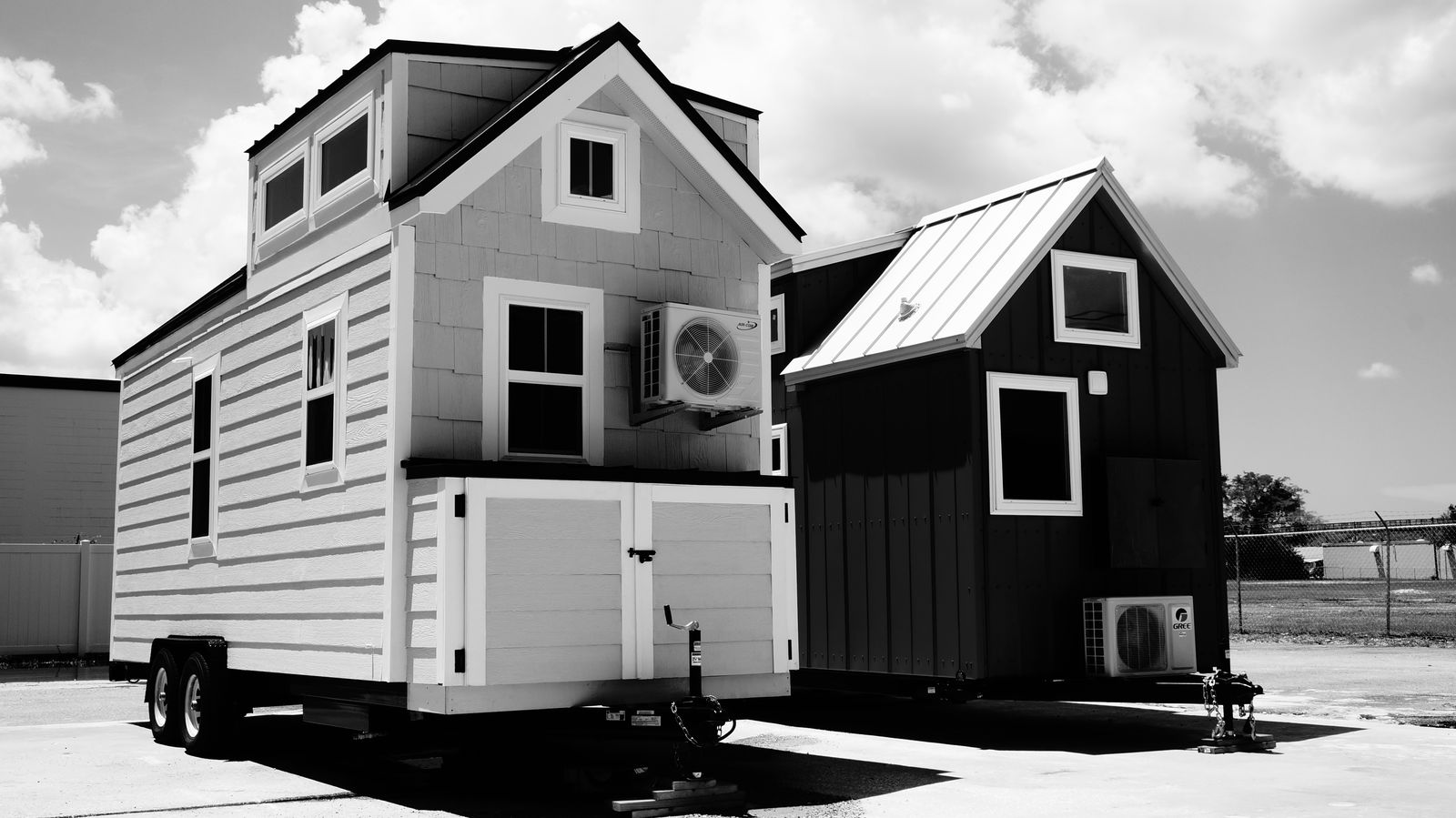
The short answer
A tiny house on wheels (THOW) is legally a vehicle. A tiny house on a foundation is legally a house. Almost every practical difference flows from that: where you can put it, whether you can live in it full time, what loan you can get, who will insure it and what happens in a flood.
Neither is better. They solve different problems. Wheels buy you flexibility and skip the land purchase. A foundation buys you legal permanence and normal financing.
Side-by-side
| On wheels (RV) | On a foundation (dwelling) | |
|---|---|---|
| Built to | NFPA 1192 (RVs) or ANSI A119.5 (park model RVs) | Residential building code; Florida's code includes the tiny house appendix (Appendix Q) |
| Federal status | Exempt from HUD manufactured home rules if designed only for recreational use, not as a primary residence | Regulated like any house by the local building department |
| Max size | Road-legal width 102 in (8.5 ft); park models up to 400 sq ft in setup | Appendix Q covers 400 sq ft or less, excluding lofts |
| Permit | Usually none to build; title and registration like a trailer | Building permit, inspections, certificate of occupancy |
| Where it can go | RV parks, campgrounds, and land zoned to allow RVs or tiny homes | Any lot where zoning allows a dwelling or an ADU |
| Full-time living | Depends on local zoning; the RV standard itself assumes recreational use | Yes, once permitted |
| Typical financing | RV loan, personal loan, builder financing | Mortgage or construction loan (if it qualifies), HELOC for an ADU |
| Insurance | RV policy or specialist tiny home policy; many require certification | Homeowners-style or dwelling policy |
| NFIP flood insurance | RVs not covered | Covered as a building |
Square footage planner
Pick your bed, kitchen and bath. Watch the floor plan draw itself and see what trailer length you need.
Try itWhat makes a tiny house on wheels an RV
The federal line is drawn in 24 CFR 3282.15. HUD exempts a recreational vehicle from its manufactured home rules if it is not certified as a manufactured home, is "designed only for recreational use and not as a primary residence or for permanent occupancy," and is either self-propelled or built and certified to NFPA 1192 or ANSI A119.5.
Park models certified to ANSI A119.5 also have to carry a Manufacturer's Notice, displayed in the kitchen until the sale closes, saying the unit is "designed only for recreational use, and not for use as a primary residence or for permanent occupancy."
Read that again before you plan to live in one full time. The certification that makes a THOW insurable and financeable also states it isn't meant to be a permanent home. Whether you can live in it anyway is up to your local zoning, not the RV standard.
Travel trailer vs park model
- Travel-trailer-style tiny homes stay road-legal. Federal rules bar states from imposing a width limit other than 102 inches (23 CFR 658.15). Florida caps vehicle height at 13 feet 6 inches (Fla. Stat. 316.515). Florida's definition of a travel trailer limits body width to 8.5 feet and body length to 40 feet (Fla. Stat. 320.01). Example: Escape's Traveler One listing says it carries the RVIA seal and is classified as an RV.
- Park model RVs are built to ANSI A119.5. RVIA's definition caps them at 400 square feet of gross trailer area in setup mode. Florida's statute defines a "park trailer" as up to 14 feet wide and 400 square feet when built to ANSI A119.5, "designed to provide seasonal or temporary living quarters." Wider units need oversize permits each time they move.
What makes something a manufactured home instead
HUD's definition (24 CFR 3280.2) covers a structure that is 8 body feet or more wide or 40 body feet or more long in traveling mode, or 320 square feet or more when erected, built on a permanent chassis and designed as a dwelling. Manufactured homes are built to the HUD code, not the RV standards, and most are far bigger than a tiny house.
What makes a foundation tiny house a dwelling
On a foundation, a tiny house is regulated by the building code like any other home. The model code written for it is the tiny house appendix to the International Residential Code (Appendix Q in the 2018 IRC, renumbered AQ in 2021).
Key numbers from the appendix text:
- Tiny house: a dwelling of 400 square feet or less in floor area, excluding lofts
- Ceiling height: at least 6 ft 8 in for habitable space and hallways; 6 ft 4 in for bathrooms, toilet rooms and kitchens
- Lofts: at least 35 square feet of floor area and at least 5 feet in every horizontal direction
- Loft ladders: rungs at least 12 inches wide, spaced 10 to 14 inches, at a 70 to 80 degree incline
- Egress: loft roof windows count as emergency escape openings if the bottom of the opening is no more than 44 inches above the loft floor
A Florida House staff analysis from 2024 says the 2020 Florida Building Code added Appendix Q, setting statewide standards for tiny houses on permanent foundations. Florida details are in are tiny homes legal in Florida.
The building code is only half of it. Zoning decides whether a 300 square foot house is allowed on your lot at all. Many single-family zones have minimum house sizes; an accessory dwelling unit is often the easier legal path.
What about a "movable tiny home" category?
Florida tried to create one. CS/HB 557 (2024) would have let movable tiny homes built to the Florida Building Code be used year-round. The staff analysis notes that under current law a movable tiny home can register as a "park trailer," but that status is "limited to seasonal use." The bill died in the House Commerce Committee on March 8, 2024.
Financing: the biggest practical difference
On wheels, you're borrowing against a vehicle. On a foundation, you may be able to borrow against real estate. Rates and terms differ accordingly.
- Mortgages need real property. Fannie Mae requires a manufactured home to be at least 12 feet wide with 400 square feet of above-grade finished area, attached to a permanent foundation and legally classified as real property. Modular homes built to the IRC have no minimum size under Fannie Mae's guide. A THOW meets none of this.
- RV loans have limits. Tampa-based Suncoast Credit Union lists RV loans up to 15 years and $400,000, but excludes RVs "used as a primary residence." Read the fine print on every RV loan if you plan to live in the house.
- Chattel loans cost more. The CFPB reported in 2021 that about 42% of manufactured home purchase loans were chattel loans (secured by the home, not land), which generally carry higher rates and fewer protections than mortgages.
Full breakdown in tiny house financing.
Insurance
The Maryland Insurance Administration puts it plainly: a key factor is whether the home has a fixed foundation or can be moved. Insurers typically won't use a standard homeowners policy for a tiny house, and many mainstream carriers won't cover homes that aren't certified by RVIA or NOAH.
Progressive says it insures factory-built tiny homes, prefers NOAH certification, won't cover a home that's moved regularly, and treats self-constructed units as ineligible.
Flood insurance
This one surprises people in Florida. FEMA's fact sheet says the NFIP insures manufactured homes on permanent foundations and travel trailers without wheels, but recreational vehicles are not insured. FEMA treats a travel trailer as a building only if it's "without wheels" and "affixed to a permanent foundation" under local floodplain rules.
So a THOW parked in a flood zone has no NFIP option while it's on wheels. More in tiny homes and hurricanes.
Resale
There is no reliable public dataset on tiny house resale values, and anyone quoting a precise depreciation rate is guessing. What we can say from the rules above: an RV-certified THOW can be sold to buyers anywhere and financed with RV loans; a foundation tiny house sells with its land and is limited to buyers who want that lot. Uncertified DIY houses are the hardest to sell because buyers can't easily finance or insure them.
Wheels or foundation in Tampa Bay?
Around Tampa Bay, three local facts push most full-time plans toward a foundation:
- Backyard ADUs must be permitted buildings. St. Petersburg requires an ADU to be permitted and inspected as an independent unit, and Clearwater allows modular buildings and shipping containers only if they meet the Florida Building Code (St. Petersburg, Clearwater, checked October 2026). A trailer in the yard doesn't qualify.
- Mobile homes evacuate first. Hillsborough County puts all manufactured and mobile homes in evacuation Zone A, even inland (Hillsborough County, May 2026, checked October 2026). Plan on a tiny house on wheels being treated the same way.
- Flood insurance needs a building. As above, the NFIP doesn't cover RVs, which matters on any lot in a flood zone.
Wheels still make sense if you'll rent a spot in an RV park or tiny home community; options and rents are in where to park a tiny house in Tampa Bay. For a foundation, start with Tampa Bay ADU rules.
How to choose
Choose wheels if:
- You don't own land and plan to rent a spot in an RV park or community
- You may move within a few years
- You want to buy a finished, certified unit and skip permitting
Choose a foundation if:
- You own or will buy land zoned for a dwelling or ADU
- You want a permanent, legal primary residence
- You want mortgage-style financing and standard flood insurance
Either way, call zoning before you buy. Our call script is in where to park a tiny house, and real costs for both routes are in how much a tiny house costs.
Questions people ask
Can I live full-time in an RVIA-certified tiny house?
The certification itself says no. HUD exempts RVs from manufactured-home rules only if they are designed for recreational use and not as a primary residence or permanent occupancy. Whether you can live in one full time is then a local zoning question. Some places allow it in RV parks or specific zones; many residential zones don't.
What is IRC Appendix Q?
It's the tiny house appendix to the International Residential Code. It covers dwellings of 400 square feet or less, excluding lofts, and relaxes ceiling heights (6 ft 8 in for habitable rooms, 6 ft 4 in for bathrooms and kitchens) and loft access rules. A Florida House staff analysis says the 2020 Florida Building Code added it.
Is a park model RV the same as a tiny house on wheels?
Both are RVs, but they are built to different standards. Park models follow ANSI A119.5 and are capped at 400 square feet in setup mode; many are wider than 8.5 feet and need permits to move. Travel-trailer-style tiny homes follow NFPA 1192 and stay road-legal at 8.5 feet wide.
Can I get a mortgage on a tiny house on wheels?
Generally no. A mortgage needs real property. Fannie Mae requires manufactured homes to be at least 12 feet wide with 400 square feet of finished area, on a permanent foundation and titled as real property. A tiny house on a trailer fails all of that, so buyers use RV loans, personal loans or builder financing.
Does flood insurance cover a tiny house on wheels?
Not while it's an RV. FEMA's manufactured home fact sheet says recreational vehicles are not insured by the NFIP. FEMA treats a travel trailer as a building only when its wheels are removed and it's permanently affixed to a foundation under local floodplain rules.
Sources
- eCFR — 24 CFR 3282.15, Exclusion of recreational vehicles
- eCFR — 24 CFR 3280.2, Definitions (manufactured home)
- RV Industry Association — Membership and standards policy (park model RV definition)
- Florida Statutes 320.01 (2025) — Definitions
- Georgia DCA — Tiny houses appendix (IRC Appendix Q text)
- ICC Building Safety Journal — Adoptable appendices for cob construction and tiny houses
- Florida House of Representatives — CS/HB 557 (2024) staff analysis
- Florida Senate — CS/HB 557 (2024) bill history
- eCFR — 23 CFR 658.15, Width
- Florida Statutes 316.515 (2025) — Maximum width, height, length
- Fannie Mae Selling Guide B2-3-02 — Factory-built housing
- CFPB — Manufactured housing loan borrowers face higher interest rates (2021)
- Suncoast Credit Union — RV loans
- Maryland Insurance Administration — Insuring your tiny house
- Progressive — Can you insure a tiny home?
- FEMA — Glossary: travel trailer
- FEMA — Manufactured homes NFIP coverage fact sheet (Aug 2025)
- TinyHouse.com — Escape Traveler One listing
- City of St. Petersburg — Accessory Dwelling Units
- City of Clearwater — Accessory Dwelling Units (ADUs)
- Hillsborough County — Evacuation zones for the 2026 hurricane season (May 2026)
Prices and rules change. We list the date we checked; confirm anything you're about to spend money on with the seller or your local permitting office.